Short answer. Yes, you can still use Space Bunny Alpha for free, but only on OpenCode Zen. Pick
opencode/space-bunny-freein the OpenCode app or CLI. You don't need an account. The free allowance is counted per IP per day, and Zen has not said when the offer ends.[1]The other four channels stopped on 5 and 6 October.
Space Bunny Alpha turned up on 23 September with no maker's name attached, a 1M-token context window, and a price of zero on five channels. For two weeks it was one of the most used models on the free circuit. Then the channels started switching it off, and the company behind it still hasn't come forward.
The first half of this page gives you the conclusions. The second half is the deep dive: each channel's story, the day-by-day timeline, every outside test and what people said.
Where it was free, and when that stopped
| Channel | Free from | Free until | How we know it ended |
|---|---|---|---|
| OpenRouter | 23 Sep | 5 Oct | OpenRouter posted that the stealth period was over.[2] |
| Command Code | 24 Sep | 5 Oct | Its own "till Oct 5" notice, then 404s.[3] |
| Kilo Code | 23 Sep | 5 Oct | The model page said "retires Oct 5".[4] |
| OpenCode Go | 23 Sep | 6 Oct | Go switched to a paid version.[5] |
| OpenCode Zen | 23 Sep | still free | "Free for a limited time", no date.[1] |
One trap if you arrive from a search: Kilo's web page still shows the model as free, a week after it left Kilo's CLI. The CLI is the better guide.
Using it on Zen today
Open the OpenCode app or CLI and choose opencode/space-bunny-free. There is no sign-up and no card. Before you build anything on it, three things:
- The allowance is per IP per day. Zen doesn't publish the number. If many people sit behind one IP, an office network or a VPN for instance, they probably draw on the same allowance.
- Zen promises zero data retention and no training on your prompts.[1] That covers Zen's own handling. Who runs the model behind it is still unknown.
- It can stop without notice. Every other lane has already closed. Keep a fallback ready.
How good is it
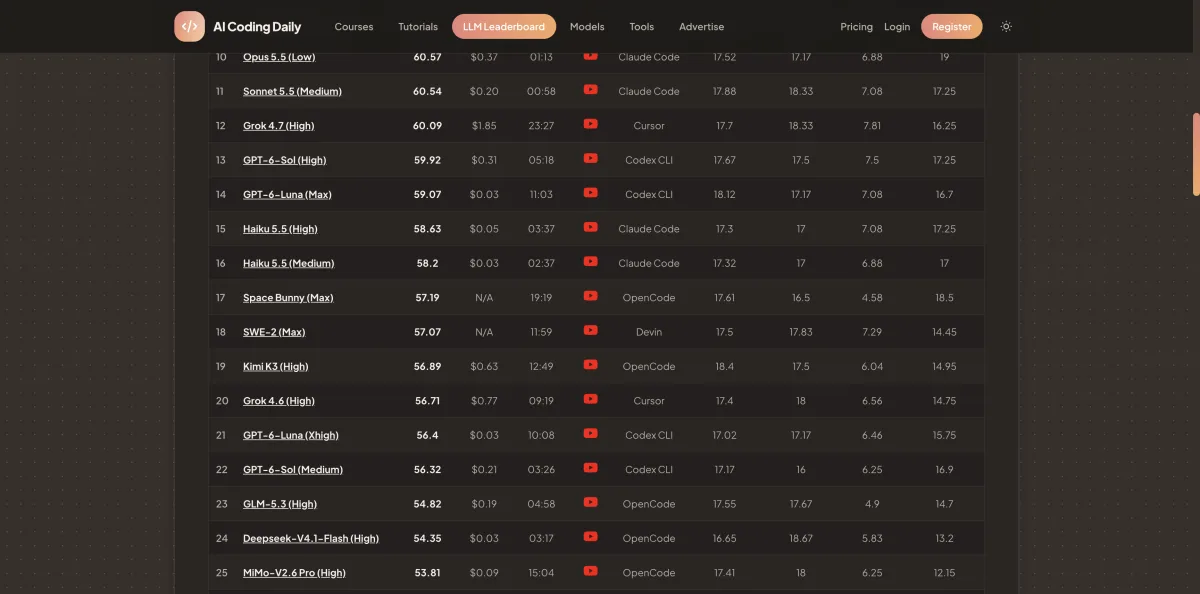
Artificial Analysis hasn't scored it yet, which is normal for a model nobody has named. Our estimate puts it at 43 to 48 on their scale, middle of the pack among coding models rather than near the top. Treat that as a rough guide: it rests on a single public benchmark, the AI Coding Daily leaderboard, where it sits 17th out of 42.[6] How we convert benchmarks is on the methodology page.
The outside tests that exist all used small question sets, so they don't move our estimate. They do agree with it. You'll find each one in the deep dive.
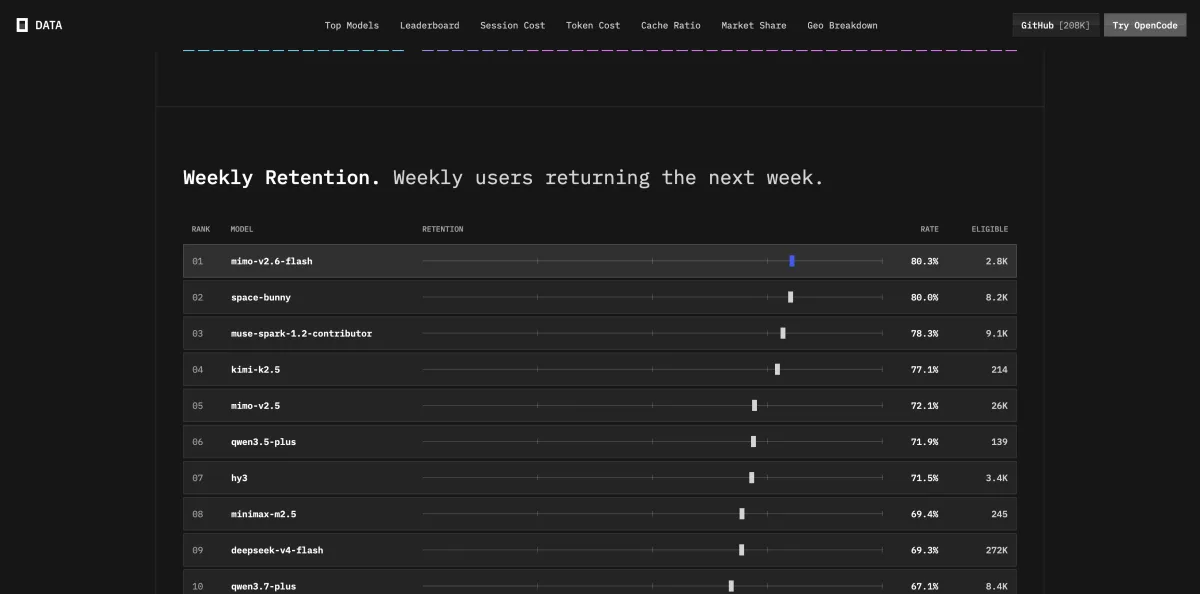
Usage tells you more. At its peak it was the third most used model of the week on OpenRouter.[7] On OpenCode it was third by tokens, and its weekly retention of 80% was the second highest on the platform.[8]
Where it came from
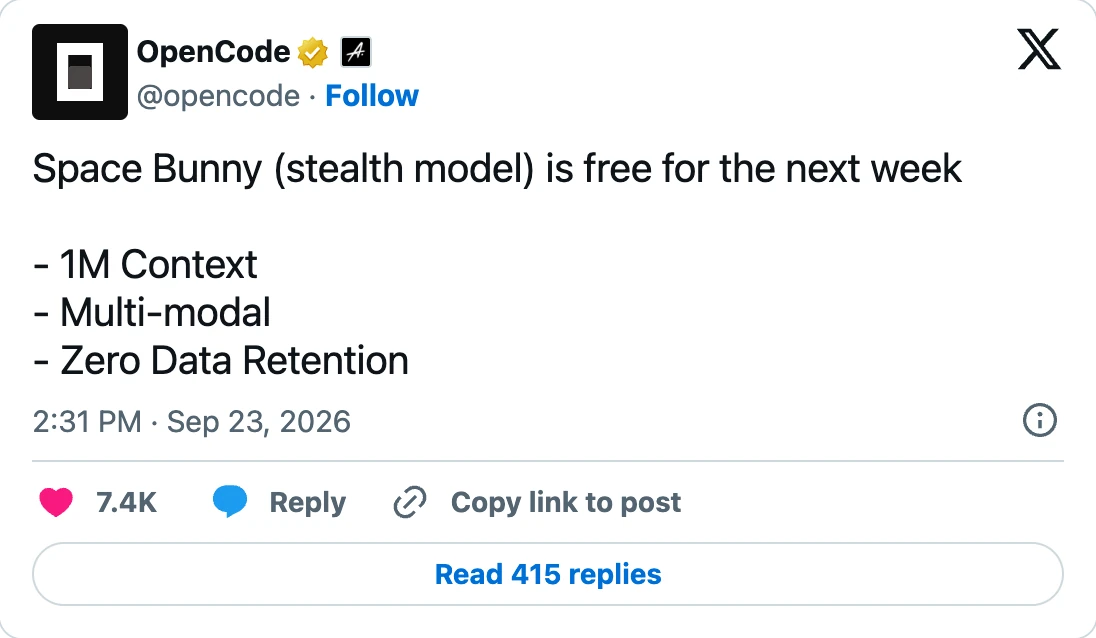
Nothing leaked first. OpenCode announced it at 14:31 UTC on 23 September as free "for the next week", with a 1M-token context and multimodal input.[9] OpenRouter's post followed eighteen minutes later, describing "a flash model with fast inference, adjustable reasoning".[10] The two posts don't quote each other, so they look like two channels launching on one schedule rather than one repeating the other. The launch wasn't smooth either. Half an hour in, OpenRouter took it offline because the provider was "working through an issue on their side", and it came back within three hours.[11][12]
Who made it
Nobody has said. On 5 October OpenRouter promised the model "will be revealed soon".[2] Eight days later its model page still describes an anonymous provider and says OpenRouter only routes the requests.[13]
Most of the evidence points at MiniMax, and nearly all of it comes from one technique, tokenizer fingerprinting (explained below). Several groups ran it independently and got the same answer. But an older MiniMax model matched too, so the evidence points at the family rather than any single release.[14]
| Claim | How solid |
|---|---|
| The maker hasn't been named, and OpenRouter only routes the traffic | Confirmed by OpenRouter's own page |
| It comes from the MiniMax family | Likely. Several independent tokenizer tests agree, though none is official |
| It is specifically MiniMax M3.1 | Possible. Specs and timing fit, but an older MiniMax model matched the fingerprint too |
| It is a Google, Gemini or Mistral model | Unsupported. Forum guesses with no tests behind them |
| "85% sure it's MiniMax", "486B parameters" | Single sources, not checkable. We don't repeat them as fact |
We know the neighbourhood, not the house.
What we're watching
- When Zen stops. OpenCode hasn't said. The "Where it's free now" box at the top is rebuilt from current data every time the site is built.
- A name. The maker section changes only if OpenRouter or the maker names the model.
- A comeback on the other four channels. None has been announced, and Go now sells it as a paid model.
- A proper benchmark. Once the model is named, Artificial Analysis will probably score it, and our estimate will give way to a real number.
Deep dive
Everything below is detail behind the conclusions above, for anyone who wants to check our work or follow a thread further.
How each channel ended
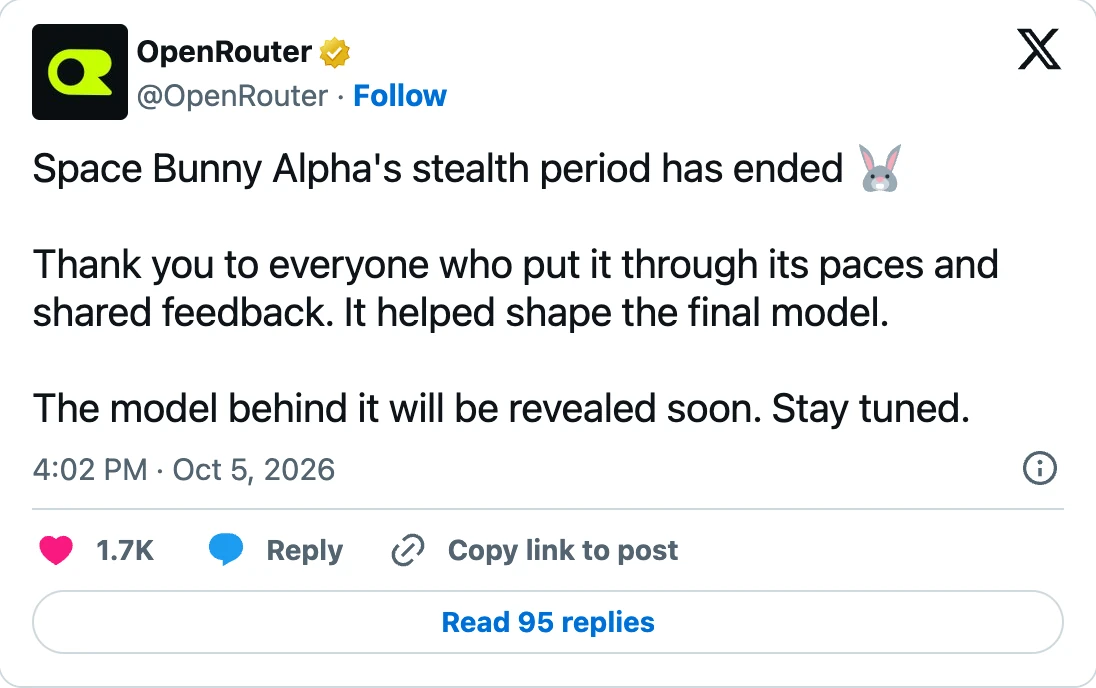
OpenRouter carried it as stealth/space-bunny-alpha from launch day.[10] The stealth period was meant to be short. On 30 September OpenRouter extended it through 5 October,[15] and at 16:02 UTC that day it posted that the period had ended.[2] The model page now carries a banner saying the free period is over.[16]
Command Code joined a day late, announcing it on 24 September for all plans.[17] On 1 October it set an end date, free "till Oct 5 on all plans",[3] and kept to it. From 19:02 UTC on 5 October our calls came back with a 404, and the next day's changelog retired "the two free stealth preview models".[18] Of the five, this lane has the cleanest paper trail.
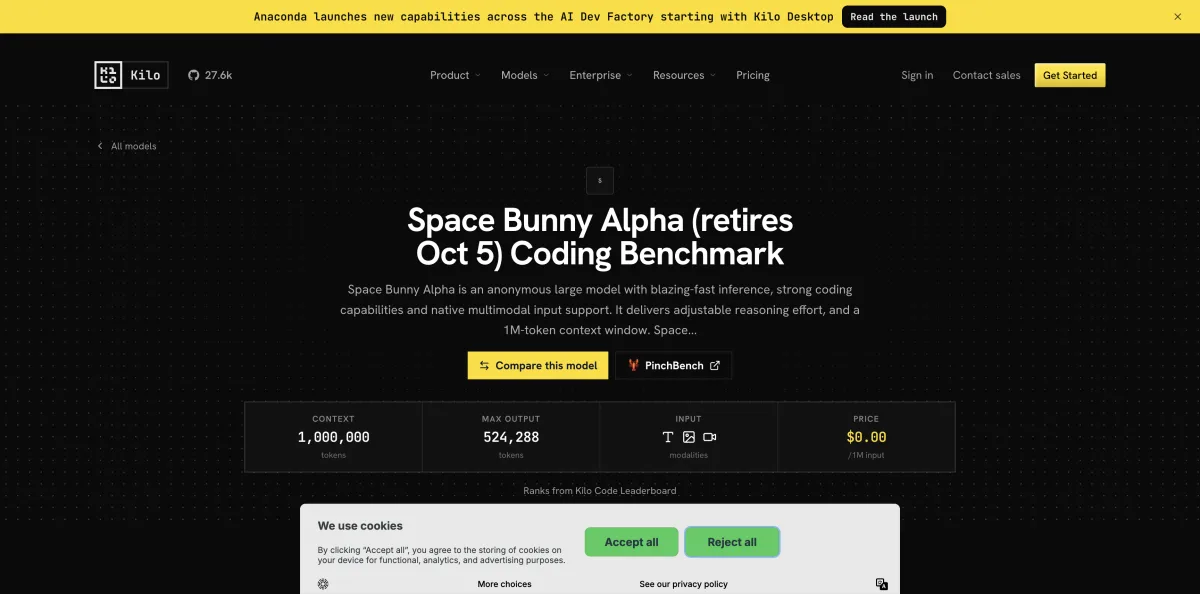
Kilo Code listed it from 23 September. By early October the page title read "Space Bunny Alpha (retires Oct 5)",[4] and on 6 October the model was gone from Kilo's CLI. The web page hasn't caught up. On 12 October it still said "Available at no cost".
OpenCode Go is OpenCode's paid subscription, and for two weeks it also carried a free promotional version, added on launch day with a limited-time flag.[19] Go outlasted Command Code by a little: at 19:06 UTC on 5 October it was still answering. On 6 October calls started failing with a generic server error, and a change titled "list paid Space Bunny" went in.[5] The model didn't leave Go. It just stopped being free there.[20]
OpenCode Zen added it to its docs on launch day[21] and still lists space-bunny-free.[22] On 6 October it answered our test prompts with no account, ten in parallel, from two different networks.
The two weeks, day by day
All times are UTC.
- 23 Sep, 14:31. OpenCode announces it free "for the next week".[9]
- 23 Sep, 14:49. OpenRouter launches it as a free stealth model, taking text, image and video.[10] Kilo and OpenCode Go list it the same day.
- 23 Sep, 15:18. OpenRouter pulls it over a provider issue.[11] It is back by 17:29.[12]
- 24 Sep. Command Code adds it on all plans.[23] The first MiniMax guesses spread on X and linux.do.[24][25]
- 28 Sep. It tops OpenRouter's daily chart, according to one write-up that quotes the dashboard.[14] MiniMax releases M3.1-Flash-Preview around the same time, without mentioning Space Bunny.[26]
- 29 Sep. An Ask HN thread asks who is behind it.[27]
- 30 Sep. OpenRouter extends the free period through 5 October.[15]
- 1 Oct. Command Code sets the same end date.[3]
- 5 Oct. OpenRouter ends the stealth period at 16:02.[2] Command Code stops answering at 19:02. Kilo's page says it retires that day.[4]
- 6 Oct. Go switches to a paid version,[5] and Kilo's CLI drops it. Zen still answers.
- 13 Oct. The maker is still unnamed,[13] and Zen is still free.
We found no sighting before 14:31 on 23 September. One Chinese investment blog says it went live on the 22nd, but nothing else we could read supports that date.[28]
Every outside test
- AI Coding Daily (the one benchmark we count): 17th of 42, 57.19 out of 70.[6]
- Fellipe Soares reviewed several stealth models side by side on 4 October.[29] Space Bunny scored 53 on his combined index, level with Fledge Alpha and behind Big Pickle at 57. It solved 64% of a 14-task Terminal-Bench subset, 75% of a 20-task SWE-bench sample, and all 15 tasks in a harness built on the jinja Python project. He says himself that subsets this small don't separate close models.
- StealthMark grades stealth models partly on SVG drawing tasks and puts it 12th of 43 with 49.4.[30] It did far better on the visual tasks than on general reasoning, which fits a model launched as multimodal.
- Kilo's leaderboard ranked it 39th in its legacy Orchestrator mode.[4] That only compares models inside Kilo.
- spacebunnyalpha.com, a fan-run page, reports much higher numbers, including 82% on a 60-question slice of GPQA Diamond.[31] Self-tested and built on subsets, so we wouldn't lean on it.
- A misattributed number. The 56.4% GPQA figure sometimes quoted for Space Bunny belongs to Glyph Cluster, a different stealth model.[32]
On OpenCode, daily use peaked on 5 October, the day three channels shut it off, and fell by more than two thirds within a week as only Zen was left.[8]
What people said
- X. Mark Kretschmann wrote on 24 September that fingerprinting pointed to a MiniMax M3.1 preview, adding that nobody had confirmed it.[24] TestingCatalog carried the claim to Threads.[33] Vaibhav Sisinty skipped the question and called it "genuinely good at coding".[34]
- Reddit. The most technical work. A post titled "M3.1 is SpaceBunny" reported seven test strings whose token counts matched MiniMax models, and a sibling post claimed six more matches against GLM, DeepSeek and others.[35] We could only read these through search snippets, so they are leads, not proof.
- Hacker News. Guessing, never knowing. On launch day one reply simply passed on that "folks on Reddit" thought it was MiniMax.[36] An Ask HN asked outright who was behind it,[27] and later comments repeated the tokenizer rumour[37] or mentioned "hints" of a MiniMax variant.[38]
- Chinese forums. On linux.do the MiniMax guess appeared on launch day, first from the look of a drawing the model made.[39] Replies the same day mentioned a token test hitting MiniMax,[40] and a day later a post called a token test "basically confirmed".[25] We have only titles and snippets from those pages. V2EX produced a single topic, with no replies.[41]
- Chinese press. Guancha reported 24 independent token probes and added the key caveat: models can share a tokenizer, so a match shows kinship, not identity.[42] Other outlets relayed a 50-string test whose primary page we could not find.[43]
- A headline that overshot. StartupFortune's title said MiniMax had slipped a new model into its tool, while the article underneath said nothing was confirmed.[44]
- MiniMax itself. When it released M3.1-Flash-Preview, one Chinese developer replied with open surprise that it apparently wasn't Space Bunny after all.[45] MiniMax has not claimed the stealth model.
How tokenizer fingerprinting works
Every model breaks text into pieces called tokens before reading it, and each family does this in its own way. Send a model some unusual strings, odd symbols or rare words, count how many tokens it reports, and you get a pattern. Do the same with models whose makers you know, and you can see which one the mystery model matches.
The method has two limits. Different models can share a tokenizer, so a match shows relation, not identity.[42] And when one careful write-up tested older models, MiniMax's M2.7 matched as well, which is why the evidence stops at the family.[14] A couple of other clues fit the same family: MiniMax's own coding tool reportedly named M3.1 before launch,[46] and the published specs line up. None of it is a confirmation.
Other guesses and loose numbers
Not everyone said MiniMax. Threads on Reddit and 4chan floated Gemini 4, a Mistral project and Google in general.[35] The guesses contradict each other and none came with a test, so they mostly show that the crowd never fully agreed.
A few numbers travel with the story and are worth recognising when you see them:
- "About 85% likely MiniMax." From a personal investment post on Xueqiu, which also mentioned 486 billion parameters and called that unconfirmed.[28] Its main source was an article we could not find.
- "50 out of 50 strings matched." Relayed by several Chinese outlets, all pointing back to a site called YFarmX. We couldn't locate the original page.[43][47]
- Specs that match MiniMax's plans. The 1M context, multimodal input and adjustable reasoning all fit what MiniMax was building. Several models share that shape, so overlap names a candidate, not an answer.
Disclosure: freetokens has no commercial relationship with any channel or company in this article.